

Breaking Up Is Hard To Do
Issue #12 of “What’s Her Problem?”: Breaking up with a doctor is as hard as ending any other relationship, but it’s important for patients to find the care they deserve.

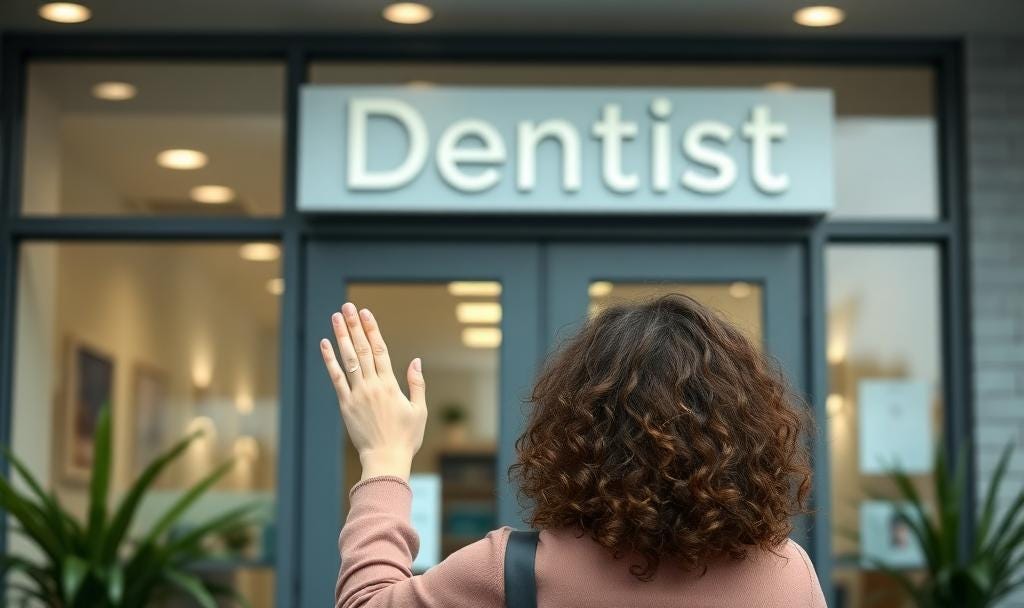
A getting-to-know you period. Chemistry. The formation of a deeper bond based on mutual trust and understanding. Making long-term plans to see each other.
The hopeful among us enters a new relationship with cautious optimism, as we suss out how we feel about each other, and upon seeing positive signs, settling into a mutually agreeable arrangement.
I’m talking about finding a new doctor.
But, in both dating and doctors, it is just as important to be able to identify when the relationship isn’t serving us as when it is.
The last time I made a long-distance move, I had to find new medical practitioners in every field, including a new dentist (and I was a big fan of my old one). As in dating, my first choice would have been to find someone through a personal connection. “Our neighbor swears by so-and-so” or “I’ve been going to this guy for 20 years” would have been nice, but the only word-of-mouth recommendation my local connections made didn’t take my insurance.
Instead, I embarked upon what felt like some bizarre version of online dating. The area I live in is chock full of franchised dental offices with negative online reviews, so I went a step beyond my normal level of intense research to scour the internet for a dentist that was the perfect combination of location, skill, and positive reviews, evaluating each of their profiles to discern if we would we be a good fit.
Insurance company provider search tools are a good starting point to find local doctors who take their coverage, but they aren’t typically a great way to glean much information beyond surface level. Websites with reviews like HealthGrades, Google Reviews, or ZocDoc1 are a reliable place to research a narrowed list and a good way to start seeing trends.
It can become apparent very quickly if a doctor has a helpful admin team, runs on schedule, or has good bedside manner. Generally, people are more motivated to go online and leave a review if something has gone wrong than if everything is a-okay, and you need to decide for yourself if 13 strangers giving someone an average of 4 stars on Google outweighs any other deciding factors. In other words, how much weight do you give to a review from someone’s ex?
I liked the dentist I ultimately selected, and I bonded with one of the hygienists in her office. For five years, we maintained our relationship, in large part due to the fact that they were sympathetic to my request for appointment times when the office was practically empty.
One of the clear instructions I received when I had my ICD (Implantable Cardioverter Defibrillator, which is both a pacemaker and defibrillator) implanted was that I couldn’t let a dentist use an ultrasonic scaling machine called a cavitron to clean my teeth, and I couldn’t sit too close to one that was in use on another patient. It could interfere with my device’s functionality.2 Hand scaling works just as well, and this hygienist was happy to book me at the end of her work day, when the other hygienists had wrapped up and turned their cavitrons off.
The relationship with the dentist and hygienist was good enough that I was willing to ignore the administrative messes their office frequently made. Billing problems regularly arose, and I often received calls asking for things I had already given to them.
At some point, I knew I was settling for a relationship with clear red flags. But I had become disabled, and shortly thereafter, a worldwide pandemic began. I had limited energy for the work involved in making a change. And like many relationships where the parties stay too long, I was afraid to start over again, and I didn’t want to date around.
In December 2021, however, we reached a breaking point.
I was scheduled to get my teeth cleaned on a Wednesday at 4:00pm. It was only my second cleaning since emerging from my pandemic-induced quarantine life. Nearly 2 ½ years had passed since I was last able to drive, so my father set aside the time to drive me to the appointment. As punctual people, we gave ourselves more than enough time to make the 17-minute drive to the dentist, but about halfway to the dentist’s office, all the cars ahead of us ground to a complete halt.
My father isn’t exactly known for his ability to handle the unexpected, so I reminded him that we weren’t in a rush and had plenty of time. He remained agitated. Ten minutes later, the traffic eased, and we were on our way again, parking at the dentist’s office with 8 minutes to spare. But his patience had already been tested.
After removing my walker from the back of the car, my father brought it around to the passenger side and waited as I slowly and painfully lifted myself to a standing position. I had only recently graduated from a wheelchair to a walker. He trailed closely behind, as I gingerly walked to the office door, lest I stumble, my unsteadiness making the short distance feel incredibly long.
The receptionist and I exchanged greetings as we entered, and I approached the desk, while my father went to sit down in the waiting area.
“Let me make sure we’ve got all your paperwork on file,” the receptionist said.
Since they were always losing things, I was prepared to furnish my insurance cards. To my surprise, she said “we’ve got all of your information on file, so you’re all set. You can take a seat, and the hygienist will call you when she’s ready.”
“OK, great,” I said, turning to slowly shuffle away.
“Wait,” called out the receptionist. “Did anyone tell you that your usual hygienist doesn’t work here anymore?”
“Noooooo,” I replied, as I slowly turned back towards her, my mind already spinning.
“She moved to Atlanta last month,” she said.
“I wish someone had told me,” I replied. “I have a lot of very specific needs that she has been helpful with, and it’s tough to start over with someone new. Does the new person know I need the hand scaling instead of the cavitron, and am I still the only person scheduled in this time slot?”
“Oh…..um….it looks like we consolidated the schedule when she left, and there is one other patient scheduled at the same time as you. Oh hey, look! There is a big note on your file that says not to schedule anyone else at the same time. Seems like someone ignored that.”
I let out a sigh of exasperation and looked around the room to see if the other patient had arrived yet. So far, it was still just my father and I.
“Maybe it’s best if we reschedule your appointment,” she suggested.
“No,” I responded, sharply. “That just won’t work. I can’t drive right now, so both my father and I blocked out the time today to come to this appointment, and it’s not fair to either of us to reschedule. You can see what a physically challenging situation I’m having right now. Is there any way you can ask the other patient, who isn’t even here, to be the one who reschedules?”
“Well, I’m not sure,” she said. “What if we did some research to see if it would be ok for the cavitron to be on during your visit?”
“I have done the research, and it’s not a risk I’m willing to take,” I said. The trust I had in the care I received there was waning.
“It’s not really fair to the other patient for me to reschedule them,” she said. She wasn’t wrong about that. And still…
Not fair to the OTHER patient?! What about me?! The person in front of you, leaning heavily on the edge of your desk because we are already several minutes past the limit of how long I can comfortably stand up.
That’s what I wanted to scream at her anyway. Instead, the tears of frustration started flowing.
Unfortunately, tears don’t really support a strong stance for self-advocacy. But at this point, I was just over it. Plus, I could see my father, who had stood up in the waiting room to investigate what was taking so long, pacing back and forth impatiently. I didn’t want to report back that we were going to have to leave and go through this whole process again another day. And I really didn’t want him to come over and yell at the receptionist, which would not have been out of character for him.
Of course, just as the tears began to spill, the front door to the office opened, and the other patient walked in. Her hygienist spotted her through the door and immediately escorted her to the back. Without having her stop at the reception desk. Without mentioning that the schedule had gotten messed up. And without asking if she was able to reschedule.
And that was the breaking point. The relationship had become unsustainable, and I needed to end it.
“I will not be rescheduling,” I announced to the receptionist. “Not now, and not ever. I will be finding a new dentist.”
“Let’s go,” I said to my father, whose ears had turned red and looked like steam may be about to emerge from them.
I’m not sure my exit really had the dramatic effect I desired, given that I couldn’t exactly storm off in a huff. I could barely move! The nerve pain in my feet was screaming at me, and my legs were exhausted from standing at the desk so long while the receptionist hemmed and hawed over what to do. So, my father and I slowly walked out the door, back to the car, and went on our way.
But I SHOWED THEM! Right? By leaving, I taught them some sort of lesson about not discriminating against people with disabilities or other medical challenges, didn’t I?
Well, not really. Because, while this breakup was completely warranted, it hurt me far more than it hurt them.
This one appointment had already had a domino-effect on my week. In order to get my teeth cleaned on Wednesday, I had moved my regular acupuncture appointment to Monday. And I was supposed to go to physical therapy three times that week, but because I had to move acupuncture to Monday, I could only squeeze in two physical therapy appointments. Physical therapy and acupuncture have been the two most helpful modalities in managing my neuropathy, and missing one of those appointments was a big deal to me.
Plus, now I had to conduct another intensive research process to find a new dentist. It would likely be quite some time before I could get my first appointment with them scheduled. And what if the first dentist’s office I found didn’t work out and I had to sort of date around again. The idea was unappealing to me.
A few days after the failed appointment, I received a phone call from a representative at the corporate office for this franchised dental practice. Apparently, the receptionist had filled her in on our unfortunate interaction, and this person was calling to apologize.
“I hope you will let me reschedule your appointment,” she said, after making some generic apologies. I got the sense she was trying to avoid more negative online reviews than their office already had.
In response, I gave her an earful, about chronic illness and disability, about the inconvenience of having my father drive me to appointments, and about the challenges of rescheduling, when that could have been avoided.
To conclude, I reiterated “No, I will not be rescheduling. I will be finding a new dentist.” This breakup was final, and we were never, ever, ever getting back together. It was time to move on.
The corporate office tried to reach out to me a few more times in subsequent weeks, but I let it go to voice mail. It was the healthy thing to do.
Eventually, I did find a new dentist, one who doesn’t work for a franchise. Our relationship is going well so far, and his hygienist is very good, but I’m not ready to make it a long-term commitment. I’m keeping my options open because I know what type of care I deserve, and I’m willing to move on again, if that’s what ends up being best for me.
Each issue of “What’s Her Problem?” includes questions for further discussion. You can Leave a Comment publicly below, or become a Paid Subscriber to join the conversation in the private community Chat.
This week’s questions:
What’s your standout doctor (or dentist) break-up story? What methods do you use to find a new doctor?

I am not endorsing any of these specific tools.
I know that some people with implanted cardiac devices ignore the cavitron rule. I also know the rules have been loosened in recent years, as technologies have advanced. Yet, as someone who is 100% dependent on their implanted device, I tend not to take risks when there is no reason to.