


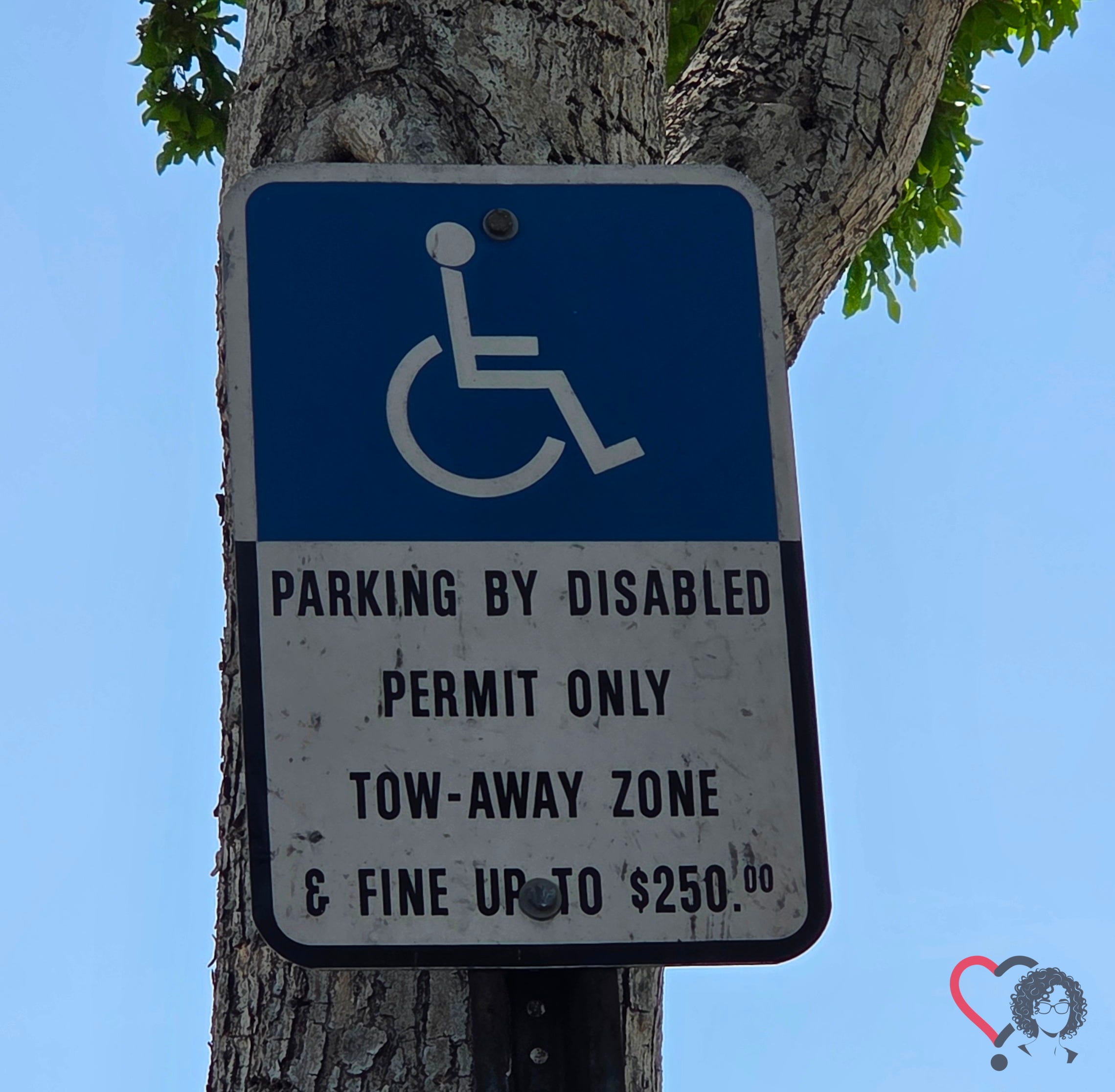
This is my third and final July article focused on life with a disability. I hope you’ll check out the first two, if you haven’t already: How to Buy an Accessible Vehicle and The Trouble with Doors.
“Disability Pride Month is observed every July to celebrate disability identity and community, mark the anniversary of the Americans with Disabilities Act (ADA), and push for full inclusion in everyday life.”1
History and Context
The 1990 Americans with Disabilities Act (ADA) put in place an excellent set of rules for accessible parking. But 36 years have since passed. Now, a greater percentage of the population is aging or has a chronic illness or disability, and more people are eligible for handicap placards (and their correlating parking spaces) than ever before.
This article takes a deep dive into the current rules, as well as some of the challenges those of us with handicap placards or wheelchair license plates face every time we enter a parking lot. My personal experience informs my viewpoint on this issue, and I think the time has come to update the ADA rules.
When I was first diagnosed with the genetic heart condition Hypertrophic Cardiomyopathy (HCM) in 2011, my primary symptom was shortness of breath. I could be found gasping for air after seemingly simple activities like walking one block, climbing a few steps, or even making my bed. My HCM symptoms only worsened in the years between that diagnosis and when I eventually had open-heart surgery to improve them, a septal myectomy to relieve the obstruction to blood flow through my left ventricle. Accordingly, I began modifying my daily activities to accommodate those symptoms.
Shopping was a prime example of a modified activity. If I went to the mall or a grocery store, I no longer took the first open parking spot I saw. I was willing to circle the lot as many times as necessary before finding the closest possible spot to the entrance. It was imperative to minimize the amount of walking, if I wanted to successfully complete the errand.
Sounds like I would have been a prime candidate for a handicap parking placard, right?
I desperately wanted one, and I would have been justified in asking my cardiologist. But I never did. All because I engaged in what I can see, in hindsight, was a ridiculous thought process.
I was worried about what other people would think. Of giving off the appearance that a female in her mid-30s (who looked much younger, at the time) was “stealing” a handicap parking spot from someone who “really needed it.” Because I couldn’t possibly be “old enough” or “sick enough” to “deserve” one. I feared the nasty looks I might get from strangers, or the comments they would make. Besides, I “just” had HCM.
When I lost all coordination and landed in the hospital with an autoimmune sensory neuropathy in 2019, I felt like I had finally “earned” the handicap placard I received before being discharged. My new wheelchair and walker were a clear symbol of my deservedness, right?
I hope you can hear the sarcasm dripping from these words.
Since receiving my own handicap placard 7 years ago, I have shifted that errant mindset. And what I’ve discovered is that not having a placard is as complicated as having one. Just in different ways.
Now, in the brief moments between when I emerge from the driver’s seat of my vehicle and when I take my walker out of the back seat, I absolutely get the critical looks I feared. The “she doesn’t have a right to park here” glares and the occasional rude comment. I just don’t care about them anymore.
I know I shouldn’t need an obvious mobility device to placate strangers. But there is also a reason some of those strangers are skeptical. Because the world of handicap parking turns out to be one filled with judgment, rule-breaking, and a serious supply shortage.
The Rules
Let’s dig into the Americans with Disabilities Act (ADA) requirements for providing accessible parking spaces, the types of handicap placards or license plates, and who is eligible to use them.
What are the ADA requirements for accessible parking?
The full ADA Requirements for Accessible Parking can be found here. However, in summary, the parking spaces are provided as follows:
All businesses, governments, or non-profit organizations must provide accessible parking spaces, which have different features than traditional parking spaces.
Those spaces must be on the “shortest accessible route” to an accessible entrance and must have marked access aisles.
There must be a handicap parking sign mounted. If it is a van accessible spot, that language must be added to the sign.
Each parking spot must be at least 96” wide (or 132” for van accessible spaces) on a nearly flat and stable, non-slippery surface.
The number of parking spaces required starts at 1, for lots with 25 or fewer parking spots, but it increases proportionately with the size of the lot or garage.
Hospitals, rehabilitation facilities, and outpatient physical therapy facilities have their own set of Accessible Parking rules.
The parking-specific portion of the ADA was updated by the 2010 ADA Standards for Accessible Design. These newer provisions account for accessibility in new construction, as well as older facilities undergoing renovations. In my opinion, although these rules are 20 years newer than the original ADA, they are still already 16 years old and need additional updates.
For example, the 2010 standards allow too many exceptions for builders and renovators to decide that accessibility features are “disproportionately” expensive, given the size of their construction budget. Parking is also treated as an afterthought, with priority given to entrances, restrooms, telephones, and drinking fountains, when all should be on equal footing. Something is better than nothing, but there remains room for improvement.
Types of Handicap Placards or License Plates
For the sake of providing a specific example, I’m going to use the rules of the State of Florida, where I live. To be clear, I don’t think Florida should generally be used as a model for most things, but I am setting that aside for the sake of this article.
There are two types of Disabled Person Parking Permits issued:
Permanent – Persons with long-term mobility impairments, or who are certified as legally blind, qualify for a permanent disabled person parking permit or license plate. Permanent permits and license plates are valid for four years and must be renewed by the permit holder’s birthdate. There is no fee for this parking permit.
Temporary – Persons with short-term mobility impairments may receive a temporary disabled parking permit for up to six months as specified by a certifying medical authority. Temporary disabled person parking permits require a $15 fee. If the need for the temporary disabled person parking permit exceeds six months, an additional temporary permit may be issued. If the additional permit is applied for within 12 months from the issuance of the first permit, no additional fee is required.2
I have the permanent placard that has to be renewed every four years. It must be hung from my rearview mirror at all times, and I am the only one who can use it.
Some people choose to apply for a Wheelchair License Plate, rather than a Disabled Person Parking Permit.
Persons with long-term mobility impairments, or who are certified as legally blind, may request a wheelchair license plate be issued for a motor vehicle registered in their name, in lieu of receiving a permanent disabled persons parking permit. The fee for a wheelchair license plate is $28 in addition to other applicable registration fees.3
Who is eligible for a placard, and how do they get it?
The most important piece of applying for either a permit or a plate is that it MUST be certified by a qualified medical authority. Your doctor is responsible for deciding whether you are eligible for a temporary or permanent permit and signing the form that you bring to the DMV, in addition to choosing your disability type.
In Florida, those types are:
"Inability to walk without the use of or assistance from a brace, cane, crutch, prosthetic device, or other assistive device, or without assistance of another person. If the assistive device significantly restores the person’s ability to walk to the extent that the person can walk without severe limitation, the person is not eligible for the exemption parking permit.
The need to permanently use a wheelchair.
Restriction by lung disease to the extent that the person’s forced (respiratory) expiratory volume for 1 second, when measured by spirometry, is less than one liter or the person’s arterial oxygen is less than 60 mm/hg on room air at rest.
Use of portable oxygen.
Restriction by cardiac condition to the extent that the person’s functional limitations are classified in severity as Class III or Class IV according to standards set by the American Heart Association.
Severe limitation in a person’s ability to walk due to an arthritic, neurological, or orthopedic condition.
Legally blind.”4
My Hypertrophic Cardiomyopathy diagnosis would have qualified me under option #5, if I had chosen to take it. Now, I qualify under options #1 and #6.
Be sure to check the rules in the state you live in.
Demand for Accessible Parking is Higher than Supply
According to the United Spinal Association, which advocates for updating the ADA accessible parking minimum standards:
“Data collected from 20 states…reveal a significant disparity between ADA standards and actual need. On average, there are 9.66 disabled placards and plates for every 100 registered vehicles, far exceeding the ADA minimum accessible parking space standards of 4% of a 100-space lot or 2% of a 500-space lot. The median figure is 8.43 plates and placards to 100 vehicles, also far above the ADA minimum standards.”5
That is a jarring statistic! It’s also one that doesn’t surprise me because the biggest challenge I encounter with my handicap placard is a lack of available accessible parking spaces.
Anecdotally speaking, I probably only get an accessible parking spot approximately 20% of the time, and there is a wide array of reasons for that. But that doesn’t lessen the ramifications.
In Florida, the size of the senior citizen population is much greater than the number of available accessible parking spaces, so I have a lot of competition for them. The local hospital’s parking garage, for example, only has the minimum number of spots required. They are all on the first floor, and they are always full. There are exactly zero accessible spaces on the other 6 floors of the garage. So, if you don’t get one on the first floor, you have to park on an upper level, probably on a ramp with a steep incline, in a narrow space, and either walk up to or down to the garage elevator.
When I end up in a regular space, my accessibility is at the mercy of how wide the parking space is and whether or not the person next to me parked crooked or over the line. I regularly have trouble getting my walker out of the car in these circumstances.
On a recent visit to my physical therapist’s office, where I usually find a regular spot that is wide enough, I had only one parking option after circling the lot for several minutes, and it was a dangerous one. A left-hand corner. I was about to be late for my appointment, so I went for it, but I could barely squeeze myself out of the driver’s side. When I got my walker out of the back, there wasn’t space to open it fully. Instead, I ended up doing a kind of shimmy/side-step to get free of the vehicle and find my footing on the sidewalk. The next time I saw that spot open, I decided to keep circling. It wasn’t worth injuring myself just to park my vehicle.
Experiences like that validate the decision I made to ensure my mobility scooter could enter and exit through the rear of my vehicle, rather than the sides. I always feel awful when I see someone who must park in a van accessible spot because they have a side ramp, but they can’t find one. Even worse when someone doesn’t respect the access aisles and parks in a way that blocks the side of their vehicle, thereby preventing the ramp from being used.
My acupuncturists’ office has 2 van accessible spots by the front entrance. But I very rarely get to park in one. There are at least 3 people, as far as I can tell, with handicap placards who work in the building and occupy those spots all day. They have every right to do that. And also, it means no one who is a customer of any of the businesses there can ever get one. I’ve mentioned to them before that they might want to encourage building management to take a look at this issue, but those managers have yet to take action.
But it’s not just me, and it’s not just what happens in Florida. According to the Accessible Parking Coalition, “69% of people with disabilities encounter difficulties finding accessible parking, with 96% emphasizing the importance of parking availability for leading independent lives. Additionally, 52% have opted not to undertake trips due to concerns about parking availability.”6
It doesn’t have to be that way.
The Rule-Breakers
One additional factor compounds the supply shortage problem. The rule-breakers.
In my experience, they come in three forms:
1. The Ones Who Want Their Doctor to Lie
The last time I brought my primary care doctor the renewal form for my handicap placard, I had a little bit of disability impostor syndrome. I asked him something like “Are you willing to sign off on this again for me?” He clearly thought I was being silly, which was a relief. “Of course,” he said. “You’re actually disabled. You wouldn’t believe how many people try to get me to sign these who don’t really need them the way you do.” And he proceeded to tell me some stories about other patients who had tried to abuse the privilege. Luckily, he was onto them.
2. The “I’ll just park here for a minute” Crowd
Most of these people are lazy. Some think they won’t get caught in their transgression, or they just flat out don’t care about the impact of their actions. Others should go get their own parking placard, if they really need the spot.
I had a recent encounter with one of the lazy ones. I pulled into the parking lot at my physical therapist’s office and saw a rare, available handicap parking space. I put on my left turn signal and was about to pull into the spot, when someone came from the other direction seeking to do the same. I had a handicap placard. They did not.
We locked eyes. I pointed at my placard. The other driver responded by zipping in front of me into the spot. As he exited the vehicle, he gave me the “one minute” pointer finger before running inside the nearby day care facility, presumably to pick up his kid. The day care has a whole dedicated lot for their families, which is maybe 20 feet farther away from the entrance than the handicap spots are. I have never seen a parent use that other lot. Instead, they all use the handicap spaces.
They think they’re just parking there for a second, out of convenience. But if someone who truly needs the spot and has no alternative comes by during that time, you may have ruined their whole day. By the time I parked on the other side of the parking lot and trudged all the way to my PT’s office about 5 minutes later, the “one minute” finger dad still hadn’t emerged.
3. The Borrowers and Loaners
Aside from the fact that it’s illegal to loan out or borrow a handicap placard, it’s an abuse of the system. And abuses like this are part of the reason so many people who don’t “look” like they need one get questioning glances from other people. It’s hard to know who to trust.
Conclusion
In conclusion, handicap parking is a great accessibility tool for those of us who really need it. We just need a lot more spaces and respect for the system. It is accessible, but it isn’t quite accessible enough. Yet. There is still more work to be done.
Each issue of “What’s Her Problem?” includes questions for further discussion. Leave a comment below!
This week’s questions:
If you have a handicap placard or permanent handicap license plate, or if you are the driver or caretaker for someone who does, what has your experience been with accessible parking?
Up Next:
August 1st is this publication’s first birthday! Next Friday, July 31st, we’ll celebrate with an article focused on answering questions from you, the readers!
I find the statistics concerning, and I believe that society has a long way to go when it comes to accessible spaces.
Accessibility will be the next thing this administration takes away.