

Chronically Ill, Wildly Capable
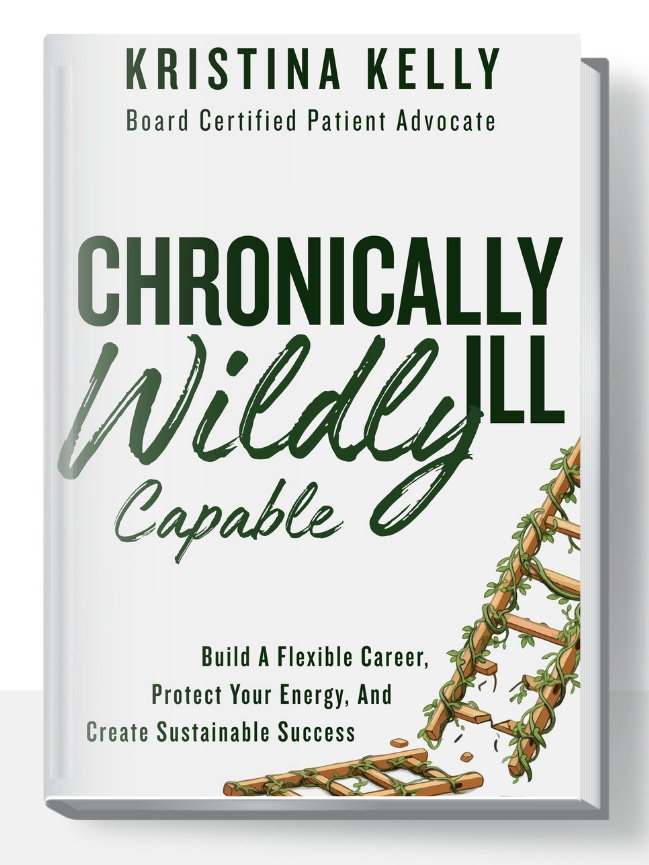
Issue #32 of "What's Her Problem?": Kristina Kelly’s new book led me to reflect on my own health-induced career transitions.

Happy first day of Spring!
A decade has now passed since I left the industry in which I had worked so hard to forge my career. Professional theatre. I will likely never return, and as a result, I’ve had to re-invent myself a couple of times in the intervening years.
I could have used a guide through that unexpected career trajectory, due to multiple chronic illnesses. And that is precisely what Board-Certified Patient Advocate Kristina Kelly’s new book, Chronically Ill, Wildly Capable, intends to do. As I read the book, I realized I was nodding a lot, seeing myself in the stories of the author and the other “spoonies” and “zebras” she interviewed. It’s exactly the kind of resource I wish I had when my body cost me my career.
Here are my 5 biggest takeaways from the book, as they relate to my own health journey:
1. Don’t Just Push Through
“A traditional full-time job assumes you can work consistent hours, five days a week, every week. It assumes you won’t need unexpected time off for medical appointments, flare-ups, or sheer exhaustion. It assumes you can function at full capacity every day, regardless of pain, brain fog, or fatigue. And when you can’t meet those expectations, it labels you as unreliable, difficult, or not a ‘team player.’”1
I was a workaholic. I expected myself to push through, even when I became increasingly symptomatic, because that’s how my workday was “supposed to” be structured. It felt like I had worked too hard to get to where I was, a leadership role as the Managing Director of a non-profit theatre company, and I wasn’t going to let anything interfere, least of all my own body.
But what was worse is that I imposed those same standards on the staff that I supervised. It shouldn’t have taken a health disaster of my own to realize how wrong I was to set those unrealistic expectations for all of us.
As Kristina Kelly says in her book, “The hustle-until-you-make-it mindset that built my career now felt downright toxic.”2 and “pushing through isn’t noble if it costs you your health.”3
Was I trying to be noble? Was I just in denial about my failing health? Either way, pushing through wasn’t the answer, and stepping away from my job to address my health and have open-heart surgery was the right thing to do, in retrospect, even though it was the hard thing to do.
2. Grieve the Loss
“Let the dream evolve. Let the timeline breathe. Let go of what you thought your career was supposed to look like and build what serves you now.”4
My identity was so wrapped up in my work that I didn’t know who I was or what I wanted to do when I had to remove myself from that position. It may not be like losing a friend or family member, but when you’ve dedicated so much of your life to something, you do have to take the time to grieve its loss.
In Chronically Ill, Wildly Capable, Kristina Kelly has a chapter called “The Identity Crisis: Who Am I Without My Job Title.” Boy, did that resonate with me. She tells the story of a former police officer who “Grieved the career she’d spent a decade building” when “the uniform was handed in and the police cruiser exchanged for a wheelchair.”5
I still haven’t entirely grieved my own loss. For example, I became a member of Actor’s Equity Association, the national union for Actors and Stage Managers, when I got my union card as a Stage Manager in late 2002. I identify myself as a Stage Manager because that role, which I did for 12 years before fully focusing on a desk job, was so well-suited to my skill set. Many of my friends are also former Stage Managers, and it’s no surprise that our personalities are complementary.
I haven’t done a show on a union contract in quite some time. Physically, it would be almost impossible for me to Stage Manage again, and I would be hard-pressed to find a theatre willing or able to make the accommodations required to make it possible. And yet, every 6 months, I pay my dues to the union because it feels like part of my identity.
It may be time to fully grieve the loss by letting my membership lapse.
3. Opt for a New Type of Employment
“Focus on future benefits rather than past investments. Ask yourself, ‘What will make me happier and healthier in the long run?’ Also, remember that life experiences and work skills are never truly lost. They will often provide a fantastic foundation for your next chapter.”6
When it was time for me to go back to work after a long and difficult recovery from open-heart surgery, I sort of had to get over the fact that my master’s degree in arts administration and 16 years of experience in the theatre industry might not correlate to future employment.
Instead, I opted for a set-up that would support my new goal to prioritize health over work. I acquired two part-time jobs, neither of which were in theatre. However, they both utilized aspects of my existing skill set.
In one, I took on a bookkeeping role, where I leaned on skills learned in graduate school and employed on a daily basis as a Managing Director. For the other, I helped a clinical psychologist with all her administrative tasks, including setting appointments, managing her client relationship system, and handling insurance claims. I had never explicitly done insurance work before, but as a strong administrator, I had no trouble getting up to speed quickly.
Both jobs could be done on my own schedule, and as long as I was getting everything done by the prescribed deadlines, all was well.
In Chronically Ill, Wildly Capable, Kristina differentiates between freelancing, multipotentialite careers, portfolio careers, and gig work. She offers thought exercises for deciding what the best fit is for you. For me, at that time, I needed flexibility and autonomy, and these two roles proved to be a good fit for that. I was “swapping a dream career for adaptive ambition.”7
Of course, most of us must take other factors into consideration, including, and especially, finances. As Kelly says, “Chronic illness can suck the green right out of your wallet.”8 Those two part-time jobs weren’t a perfect financial solution, but they were a step in the right direction towards what I hoped would be a return to full-time employment in the future.
4. Adjust to Setbacks
“wondering if success is even possible for someone in your body.”9
I didn’t think things could get worse than open-heart surgery. Yet, only a year after my recovery, I fell ill again in 2019, this time with an autoimmune sensory neuropathy. I was hospitalized for long periods, and I was getting worse instead of better. Rendered completely unable to work, I was forced to quit my two part-time jobs.
For awhile, the neuropathy in my hands was so bad that I couldn’t type, nor could I write by hand. Other physical ramifications of the neuropathy prevented me from sitting at a computer anyway. I could only sit at a desk in my wheelchair in short spurts.
I reluctantly applied for disability benefits because I wasn’t sure I would ever be able to tackle any of those work-related activities again. As someone who places a high value on my own productivity, not being able to contribute in some meaningful way left me feeling pathetic and useless, even though I know it shouldn’t have.
5. Find What Works Now, and Set Boundaries
“It’s about finding a way to contribute, create, or support yourself in a manner that aligns with your body’s needs, rather than constantly fighting against them.”10
Over time, I’ve been able to rebuild my tolerance for long stints at the computer, including writing and typing, when I was finally well enough to be able to dip my toe back into the working world and test my capacity, I wanted to be more intentional about what I chose to do with my limited time. As Chronically Ill, Wildly Capable details, there are so many options for people who want or need to forge their own path. I considered many.
But what I kept coming back to was writing and patient advocacy. Sharing my health journey so I could help others who may be going through something similar. I didn’t have any formal training in either, outside of a few writing classes, so I enrolled in Harvard Medical School’s Media and Medicine Certificate Program last Spring, where we learned “how to tell stories that make a difference.” The program provided the structure I needed to get this idea I had for a newsletter off the ground.
I sought flexibility, autonomy, and to tell my story in an impactful way. So, here we are (and thank you, as always, for being here!).
Kristina Kelly wrote a chapter on “The Imposter Syndrome: Waiting for the Fraud Police”11 as you move into a new field of work. That’s the stage I’m in now. I’m still testing the waters and building, trying to create opportunities for writing, podcasting, or speaking to come my way. As I keep telling people, I’m planting a lot of seeds and waiting for some of them to sprout.
“Businesses take time to grow. Career shifts take time to pay off. The key is to keep going, even when it feels like nothing is happening.”12
But I’m always cognizant not to overdo it, lest I suffer another debilitating setback. To that end, setting boundaries is difficult but important.
In order to succeed, I have to set boundaries with the people around me. I know my fellow Substack writers can relate to this:
“Just because you’re working from home doesn’t mean you’re not working. Your time is still valuable. You might have to remind family or friends of that more than once. It’s okay to say ‘I’m working from 10 to 3 today, but I can talk after that.’ Repeat after me: Boundaries are not rude.”13
They play a key role in work-from-home set-ups.
In order to maintain my current health situation, or even improve it, my schedule prioritizes medical appointments, and I work on projects like this newsletter in whatever time is left. As Kelly writes, “You are replaceable at a job. You are not replaceable as a friend, partner, sibling, parent, or any other role. Let that guide your choices.”14
That’s a great lesson for anyone navigating their career, with or without chronic illness.
To learn more about Kristina Kelly, Little Engine Patient Advocacy, and Chronically Ill, Wildly Capable:
www.littleenginepatientadvocacy.com
Instagram: @littleenginepatientadvocacy
TikTok: @littleengineadvocacy
Purchase “Chronically Ill, Wildly Capable” on Amazon or Barnes and Noble
Each issue of “What’s Her Problem?” includes questions for further discussion. Leave a comment below!
This week’s questions:
Have you thought about what you would do if you needed to make a career pivot? Are there other kinds of jobs that interest you? If you’ve already made a career pivot, what advice do you have for others looking to do so?
Related Posts:

Kelly, Kristina (2026). Chronically Ill, Wildly Capable. Little Engine Patient Advocacy LLC. Page 5.
Kelly, 2026, p. xii
Kelly, 2026, p. 43
Kelly, 2026, p. 168
Kelly, 2026, p. 160
Kelly, 2026, p. 24
Kelly, 2026, p. 1
Kelly, 2026, p. 143
Kelly, 2026, p. xiv
Kelly, 2026, p. 3
Kelly, 2026, p. 23
Kelly, 2026, p. 138
Kelly, 2026, p. 92
Kelly, 2026, p. 44
These are sound ideas for many people Debra, even if not chronically ill. I relate to #2 and 3 which I went through after my 3rd layoff.
I'm sorry that you are unlikely to return to professional theatre, but maybe you'll find a different way to still be connected to it that works for you.
Thanks for the recommendation, Debra.