

Good News
Issue #2 of "What's Her Problem?": Those of us with chronic illness are so used to receiving bad news from doctors that we don’t stop to celebrate the small wins when we do receive good news.

My default approach to every doctor’s appointment is to brace myself. Having dealt with chronic illness for nearly 20 years, I go in wondering what bad news they will deliver today. How many follow-up items will I need to add to my never-ending health-related to-do list? Will there be side effects to some new procedure or medication? How will my friends and family need to help me or otherwise be in the loop? Each appointment makes me feel like I’m holding my breath, and only rarely do I get to exhale.
As a result, I am simply not adept at receiving good news from doctors. Yes, I know that sounds ridiculous. Good news is what every “sick” person is desperate to hear from a medical professional--any medical professional. But on the rare occasion that there is some positive update, I feel very awkward about it.
I like to consider myself a realist. I’m not overtly positive, especially not in a toxic way, and on the flip side, I don’t consider myself a cynic either. But I have unquestionably become wary of good news. Often, I find myself just keeping it private when I do receive good news. I don’t want to get my own hopes up, much less anyone else’s. At the other extreme, an actual celebration would feel equally strange. So, what’s a gal to do?
Last year, I had a regular check-up with my local cardiologist, who monitors my day-to-day heart health. (I have an out-of-state specialist at a Center of Excellence (COE) who takes care of my Hypertrophic Cardiomyopathy (HCM). The week before the appointment, I had my annual echocardiogram, which is an ultrasound of the heart. One of the items on my list (I always bring a list!) of questions for the cardiologist was, naturally, to review the results of the echo. I was, and still am, doing a very slow taper off the steroid I take for my neuropathy, so I was nervous that a cardiac complication would emerge.
“Everything looks great!” the cardiologist reported, in a cheery yet matter-of-fact tone.
I was practically speechless.
Had a cardiologist, of all doctors, just told me that things were ok? Even, possibly, better than ok?
He sure did.
The cardiologist began to review the report with me:
Ejection fraction…normal.
Size of the left and right atria…normal.
NO aortic regurgitation.
NO mitral valve regurgitation.
Estimated PA systolic pressure…normal.
NO pericardial effusion present.
The size of the aortic root and proximal ascending aorta…within normal limits.
All other pressures and gradients, even upon exertion…normal.
My gradient, which is the difference in pressures as blood flows through the heart, was over 160mmHG (millimeters of mercury) before I had open-heart surgery, a septal myectomy, in 2016. But on this occasion, it clocked in at a mere 3mmHG. So low that my cardiologist referred to it as “basically zero.”
Before the myectomy, I never saw the word “normal” on a report, nor did my gradient come close to zero. I had severe mitral valve regurgitation and a high ejection fraction (the percentage of blood your heart pumps out each time it beats), especially upon exertion.
This report, this small win, should have been cause for a real celebration! Instead, I went straight to wondering when the other shoe was going to drop. Because it always has before.
The cardiologist asked the front desk to print out a copy of the echocardiogram report for my meticulous record-keeping purposes and bid me farewell.
I didn’t share the results with anyone, and I didn’t celebrate. I went back to focusing on all my other medical issues, feeling only a temporary sense of relief not to add something else to my list of follow-ups.
Several fields of research dive into the benefits of celebrating small wins. There are: TED Talks, many with tens of thousands of views on YouTube; psychology studies showing that it helps improve motivation and confidence; and employee performance management studies in abundance; among others.
One of the most oft-cited employee performance management reports is “The Power of Small Wins: Want to truly engage your workers? Help them see their own progress” by Teresa M. Amabile and Steven J. Kramer for Harvard Business Review (May 2011).1
I have a Master of Science in Arts Administration, a Graduate Certificate in Human Resource Management, and I have managed employees at several organizations, so I have read my fair share of management theory. Much of it is focused on systems of benefits and rewards to elicit performance. While that is important, Amabile and Kramer’s study reveals that employees may respond better to having their incremental progress encouraged and acknowledged.
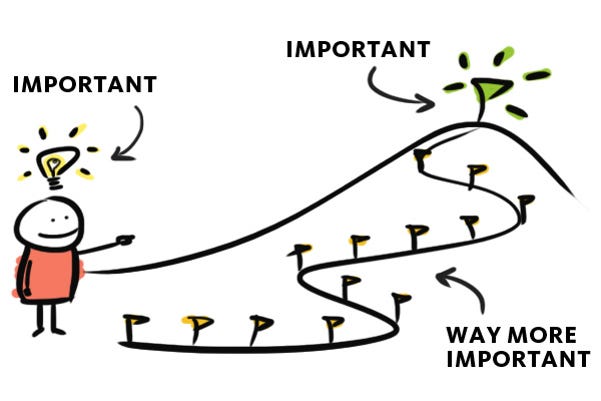
I believe their “progress principle” is equally applicable to managing chronic illness.
The progress principle is as follows:
Of all the things that can boost emotions, motivation, and perceptions during a workday, the single most important is making progress in meaningful work. And the more frequently people experience that sense of progress, the more likely they are to be creatively productive in the long run. Whether they are trying to solve a major scientific mystery or simply produce a high-quality product or service, everyday progress—even a small win—can make all the difference in how they feel and perform.
Amabile and Kramer go on to emphasize that “For the progress principle to operate, the work must be meaningful to the person doing it.”
Is there anything more meaningful to an individual with chronic illness than seeing progress in their personal health journey?
I treat managing my health as a business, and I occasionally refer to myself as “Deb, Inc.” Although I am being facetious, there is an element of truth to it.
I am my only employee. I spend most of my time scheduling and attending doctor’s appointments, handling health insurance issues, organizing medications, doing research, finding resources, and networking.
I treat my health like it’s my job because it is that important and also requires a similar time commitment.
If I am making progress, even slowly, it enables me to stay motivated.
At physical therapy, I’ve been working on the mechanics of getting down onto the floor and back up from the floor. Until a few months ago, I hadn’t been able to sit on the floor in nearly 6 years. My feet, legs, and brain just could not coordinate to accomplish that series of movements.
When I was finally able to do it, my physical therapist got really excited and high-fived me, as I sat on the ground taking in my surroundings.
“Great job!” he said.
“Thanks, but I still can’t get back up. I may live here on the floor now,” I joked.
I was doing it again. Instead of appreciating the progress with something we’d been working on for such a long time, something that was truly meaningful to me, I was skipping straight past the small win and looking to the big picture. In doing so, I was depriving myself of the positive physical, mental, and emotional boost I would have gotten if I had just taken a moment to relish in my success.
But my physical therapist knew that.
He said, “Hey, forget getting up. We’ll get there with that. Look at what you accomplished today.”
He was right.
Amabile and Kramer would agree. They wrote:
When we think about progress, we often imagine how good it feels to achieve a long-term goal or experience a major breakthrough. These big wins are great—but they are relatively rare. The good news is that even small wins can boost inner work life tremendously. Many of the progress events our research participants reported represented only minor steps forward. Yet they often evoked outsize positive reactions.
For many people with chronic illness or disability, this is an important lesson to learn. It is for me. If I spend my time only focusing on the big goal of walking without any assistive devices, which may or may not even be attainable, I will miss all the great moments of progress, the good news I’m receiving and the small wins I’m having along the way.
So too with Hypertrophic Cardiomyopathy (HCM). As a lifelong genetic condition, I will always have ebbs and flows with the severity of my symptoms. If I only focus on trying to feel “well” or like I don’t have HCM at all, not only is that unrealistic, but it doesn’t afford me any credit for the great work I’m doing managing the condition.
In May of this year, I returned to the same local cardiologist’s office for my annual echocardiogram. The following afternoon, he left me a voice mail.
“No gradient,” he said.
“Unchanged from your last echo.”
“Heart function is normal.”
“There is nothing to call me back about.”
I breathed a sigh of relief.
And by telling you about it, dear readers, I count that as celebrating this small win. I’m proud that I’ve kept things stable, two years running, despite some other complicated heart health moments in between. Amabile and Kramer were right. It does give me a boost of positivity, as well as motivation to stay on the right track.
I plan to continuing working on celebrating the victories, even the small ones, so that, hopefully, when I get my next good echo report or I eventually do manage to get myself up off the floor at physical therapy, I can spend a little more time basking in the positives. Maybe I could even get used to this?
Each issue of "What's Her Problem?" includes questions for further discussion. You can Leave a Comment publicly below, or become a Paid Subscriber to join the conversation in the private community Chat. This week’s question:
Do you celebrate your small wins with your health? If so, how do you celebrate? If not, why not? Do you subscribe to the progress principle?

Amabile, T. M., & Kramer, S. J. (2011). The power of small wins. In Harvard Business Review (Vol. 89, Number 5, pp. 70–80). Harvard Business School Publ. Corp.
Living in a constant cycle of monitoring symptoms can make positive updates feel almost unfamiliar, even hard to trust. The instinct to move past good news quickly makes sense when your baseline has been uncertainty for so long. Framing health management like meaningful work adds structure to something that can otherwise feel endless. The physical therapy moment shows how progress often shows up in ways that don’t match the original goal but still matters.
I’m so happy to hear you realize the importance of celebrating any gains you achieve, no matter how small you think they are. You have made amazing physical progress in the short time I have known you. We will continue to work hard and we will get there! 🤗