

How I Learned to Drive Again
Issue #43 of “What’s Her Problem?”: When illness takes away our independence, sometimes we can regain a different version of it.

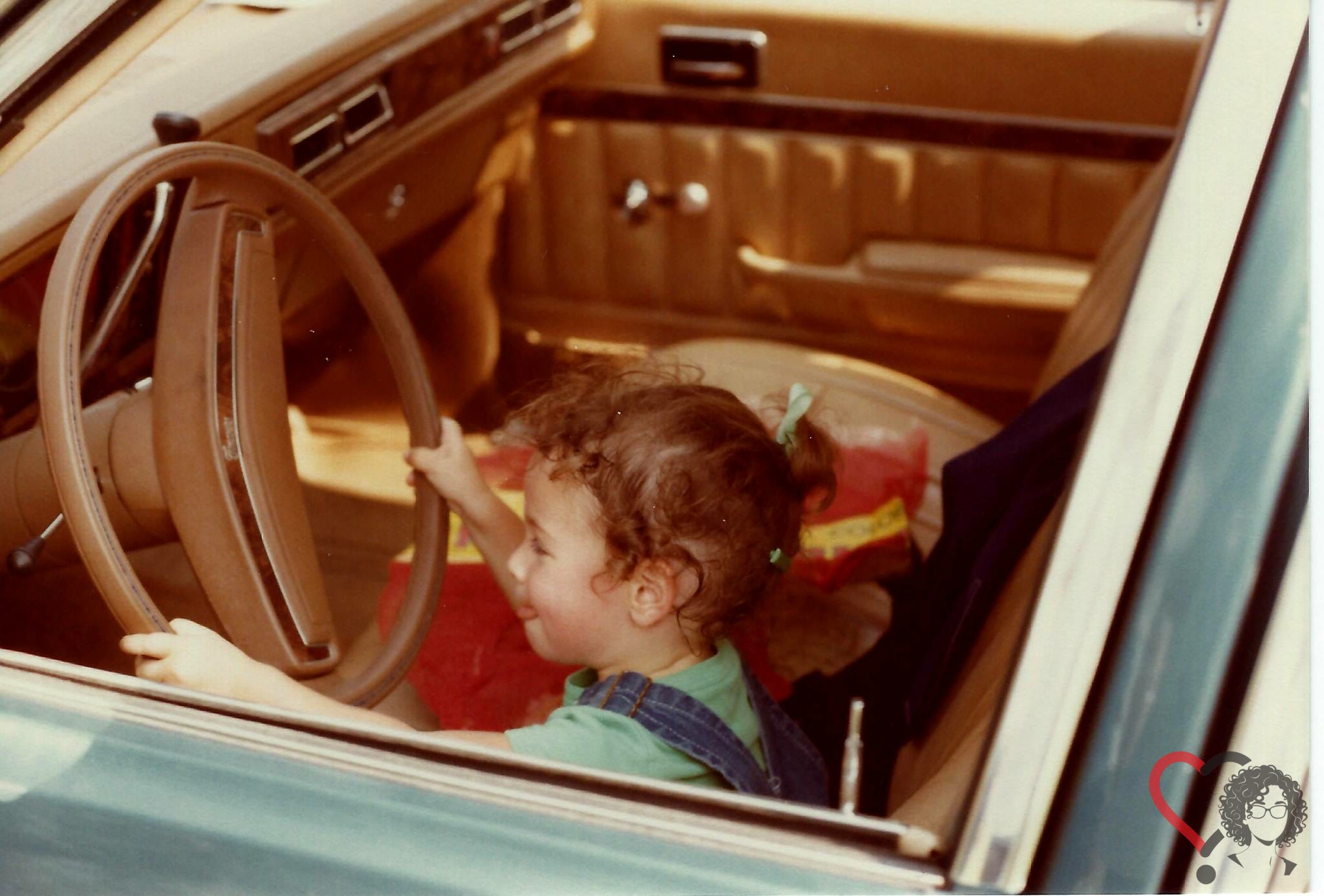
“I’m an excellent driver.”
-Dustin Hoffman as Raymond Babbitt in the 1988 Oscar-winning Best Picture “Rain Man”
I love driving. I always have. Even when I was a kid, I was always trying to find toys I could drive or driving rides at amusement parks. Of course, I had a Little Tikes Cozy Coupe…you know, the red plastic car that you drive with your feet, with the yellow roof, the big set of eyes on the front, and a steering wheel. Even my Barbie doll’s bright red Ferrari was a prized possession. In Disney World, while my peers were clamoring to ride Space Mountain, I wanted to drive the gas-powered cars at the Tomorrowland Speedway or, once I was old enough, the water sprite boats you could rent at the Polynesian Resort. And go-karts? Yes, please!
But I used to take driving for granted. Once I got my license, there were only two stretches of time when I didn’t drive: the summer of 2000, which I spent studying abroad in Spain and traveling around Europe on planes and trains; and the first 9 weeks after I had open-heart surgery, while my sternum healed. All that changed in June 2019, when I lost my ability to walk and, with it, my ability to drive. My coordination was taken from me by what I would later discover was an Autoimmune Sensory Neuropathy. It forced a driving hiatus that lasted nearly 3 years and left me yearning for a missing piece of my independence.
Life is a Highway
My best friend’s father was the first to let me drive a real car. He came to pick up my friend from my house, and I sprinted across the lawn, launching myself into the driver’s seat, just to see if he’d let me do it. To my great surprise, he did! Though, he and I have wildly different accounts of how well I did as I drove us just a short way up the street.
The day I turned 16, I got my learner’s permit; I had been waiting for that moment for years. My father was the one who taught me how to drive. We found a quiet neighborhood nearby that was less hilly than our own, with a configuration of streets that allowed me to start with a simple square of right turns only, without ever ending up on a major road. But my skills progressed quickly, and within a couple of months I was taking Driver’s Education and learning how to pull out of a skid on ice or extract the vehicle from a snow bank. Even my parallel parking was excellent, a skill that would serve me well during the 20 years I lived in the Boston area. Like the quote from “Rain Man” says, I was an excellent driver. I got my license a few months later, passing the driving test on the first try. For me, that license meant freedom.
I made a habit of going for long drives. When I was in college, I would go for a drive on a whim, and at other times I drove because I had a tough day at school and needed to relieve some stress. I would make my way from the Boston area practically to the New Hampshire border and back, to calm my body and mind, singing along to the radio as I went. As an adult, I did the same.
I knew it was a privilege to go wherever I wanted, whenever I wanted, as long as I could afford to put gas in the tank. Which is why it was so jarring, at age 40, to have to begin relying on my father for rides again. This time, to doctor’s appointments.
A Prescription for Freedom
At first, the neuropathy made it impossible to drive. I couldn’t sit for long periods of time without pain. I didn’t have full control over my feet and ankles, and I had no sensation in my feet. The neuropathy in my hands made it difficult to grip the steering wheel. And I didn’t have full range of motion with my head and neck; when I tried to turn from side to side, it set off a cascade of spasms in my pharynx that made me twitch involuntarily. In those early years of the neuropathy, it was so unsafe to drive that I didn’t attempt it.
I worked hard at physical therapy to overcome these challenges, and by the beginning of 2022, I was starting to consider getting behind the wheel again. But my confidence was shaken. My movement had been restricted for so long that, in January, I began to research what it would look like to use hand controls to drive. If I was going to do this, I wanted to be 100% sure I could do it safely.
In February, I went to see my physiatrist, the physical medicine doctor who prescribed my physical therapy and oversaw my progress. He agreed that I was ready to drive, and he wrote me a prescription for a “Driving Eval.” He explained that the local hospital, where I had spent nearly a month doing inpatient physical rehabilitation in 2019, no longer provided driver rehab. Apparently, there were insurance issues that shuttered the program. He gave me the name of another location to try, but the legwork was left to me.
My phone call to the hospital about 45 minutes away, with the only other driver rehab program, also left me empty-handed. They had suspended their program when the pandemic started, and it was likely they would never restart it. A helpful nurse encouraged me to look for a company that sells hand controls and ask them if they knew an Occupational Therapist (OT) who conducted driving evaluations. Multiple other phone calls all led to the same conclusion; there were only a couple of Occupational Therapists who did these evals for pretty much the whole state. The one they all referred me to never called back; I would later learn that she simply doesn’t return phone calls.
In March, I went to see my Neurologist and mentioned my driving evaluation struggles. He wrote me a fresh prescription and sent me off to call the guy he uses for all his patients; an Occupational Therapist who I will call Mr. G. After my first call to this new resource, I received no response…again. But my persistent self-advocacy paid off when I called a second time and got Mr. G on the line.
“It’s a good thing you called me again,” he said. “I wouldn’t have gotten to you for a few months otherwise.” The faxed prescription order from my Neurologist had landed in a rather large pile of similar documents, from the sounds Mr. G made as he rifled through them. I tried not to feel too guilty that he divulged he was squeezing me in early, possibly at someone else’s expense, due to my relatively young age (43) and my persistence.
“Can you do March 22nd?” he asked. That was only 2 weeks away. “Yes!” I replied, immediately. “Will you be testing to see if I need the hand controls?” “No,” said Mr. G. “If your Neurologist sent you to me to be evaluated, then he doesn’t think you need hand controls. You are ready to drive. Go practice a few times with someone in the passenger seat, and I will see you on the 22nd.” A wave of relief washed over me. I might be getting some of my independence back…and soon! But first I had to practice.
Three times in mid-March, I practiced driving. Just like when I was 16, there was my father in the passenger seat, and we began by making, exclusively, right turns. During the first drive, I only went up and down the side streets in my parents’ retirement community, trying to regain my bearings. Drive number two was the first time I went back onto the main roads, testing my ability to look around without inducing spasms and ensuring that I had full control over the actions of my right foot. On the third test drive, I started to feel more natural again. I was ready for the test.
Re-Assessing My Ability to Drive
Mr. G arrived as scheduled on the 22nd for my two-part assessment. We began with the cognitive portion of the exam. He asked me to make some mental calculations and do an alphanumeric exercise, both of which I did with ease. Next, there were lists of five items to memorize and repeat back. Again, no issues.
The following section of the exam was simply a conversation. I remember this part the most vividly because Mr. G wanted to talk politics. I had already assessed that we were poised at opposite ends of the political spectrum and really didn’t want to get into it with him. Mostly, I didn’t want our differing views to affect the outcome of my assessment.
Somehow, I managed to steer the conversation toward his work, which led him to tell me that he is the only OT in approximately a 5-hour driving radius who does these specific assessments. He is swamped with work, but it’s very lucrative. Mr. G made a point of telling me that anyone with a background in Occupational Therapy who wanted to learn from him could make a mint because there is a huge market for this, especially among the elderly.
As we wrapped up our conversation, the time for part two of the exam, the driving, had arrived. I was, undeniably, nervous. There was a lot riding on this. I left the driveway cautiously, drove slowly down the street to exit the community, and then made a right turn out onto the main road. Just as I had practiced with my father, Mr. G had me drive in a big square, totaling less than 2 miles, before turning back into my parents’ retirement community. Throughout our 15-minute journey, my hands were placed on the wheel precisely at 10 and 2. I obeyed the speed limit and actively checked my surroundings. Once I had pulled back into the driveway, Mr. G provided a few small pointers, and he promised to have the final report sent to my Neurologist within the next week or two.
In the end, my experience with Mr. G lasted about 2½ hours. I received a perfect score on the cognitive evaluation, and the report stated that my “Clinical and driving skills eval results did not exhibit any adverse safety concerns.” Once again, I had passed the test on the first try.

What Driving is Like Now
I would be lying if I said I felt completely comfortable getting back on the road by myself. For a long time, I stuck to daytime driving on the local streets, and it took months to work back up to getting on the highway. Even then, it was a few months more before I strayed from the right lane or drove at night.
Driving without being able to feel anything but nerve pain in my feet took some getting used to, but my confidence has grown over time, and the work I’ve done at Physical Therapy has paid off. I know that my muscles are intact, and I’ve strengthened my legs, ankles, and feet to be sure I can drive safely even if I’m having a bad neuropathy day. If I think I can’t drive safely, I don’t get behind the wheel. Overall, my love of driving has returned, alongside my confidence, and I am back to singing along with the radio as I go.
Cost of the Driving Assessment: $350.
Regaining an important piece of my independence: priceless.
Each issue of “What’s Her Problem?” includes questions for further discussion. Leave a comment below!
This week’s questions:
What does driving mean to you? Have you ever had to pass a driving assessment test as an adult?
Related Posts:

Debra, I'm so glad that this story had a happy ending and you regained your driving independence through sheer determination and advocacy for yourself. Loved the Rain Man reference!
I know there are always really long waits for specialists in FL in general and can only imagine how much worse it is for something so specialized.
I only became aware of the ability to drive a car with hand controls due to some IndyCar drivers that had accidents that required it. Two even drove race cars again with specially outfitted vehicles.
Living in NYC, I actually learned to drive late in life (age 26) and only because I was commuting 2 hours a day via public transportation out to Long Island for a short stint in retail management. I passed on the second try only because I hit the curb parallel parking, the second road test experience is a story i'll have to write one day.
Right after I got my license I went back to working in Manhattan and barely drove until my husband and I moved to CA years later. It's where I really learned to drive.